Contact information
Name:
Derek Smith
Phone:
610 330 5283
Email:
smithder@lafayette.edu
Link for More Information:


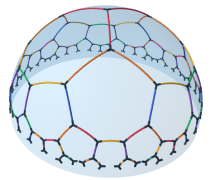
In February 1826, Nicolai Lobachevsky delivered a lecture at Kazan University (Russia), on a question that enthralled (plagued?) mathematics for over two millennia: in planar geometry, can one prove that given a line and a point not on the line, there is a unique parallel to the line through the given point? Of Lobachevsky's work on this problem, mathematician W. K. Clifford quipped “...what Copernicus was to Ptolemy, Lobachevsky was to Euclid,” while philosopher Hilary Putnam wrote “the overthrow of Euclidean geometry is the most important event in the history of science for the epistemologist.” To pile it on, Einstein said “should I not have been acquainted with it [non-Euclidean geometry], I never would have been able to develop the theory of relativity.”
Geometry (predominantly Euclidean) has been present in the Lafayette curriculum since its founding. On March 22, 1967, Lafayette College Mathematics Professor James P. Crawford delivered a Jones Faculty Lecture at the College, dramatically entitled “Mathematics--Strange Seas of Thought,” taking the audience on a journey through the discovery of non-Euclidean geometry and Godel's incompleteness theorems in logic.
In this talk we will explore the dramatic nature of the discovery of non-Euclidean geometry. We will discuss what that even means, and how mathematicians put hyperbolic geometry on equal footing logically with the still venerable Euclidean geometry of antiquity. Doing this involves geometers building representations of hyperbolic geometry using notions from Euclidean geometry, analogous to cartographers building maps of the Earth.
You should walk away from the talk better prepared to appreciate the meaning of the geometry build that will happen outside Pardee this week!