Contact information
Name:
https://fams.lafayette.edu/
Phone:
(610) 330-3242
Email:
wheatonm@lafayette.edu


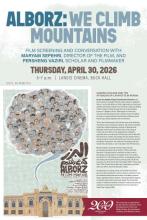
Alborz College and the Afterlife of Lafayette in Persia
As part of Lafayette College’s Bicentennial Celebration, this event revisits a remarkable and little-known chapter in Lafayette’s history. From the late 1890s until 1940, Lafayette alumni, faculty, and students were deeply involved in the founding, funding, and staffing of Alborz College in Tehran through the long-running initiative known as “Lafayette in Persia.” What began as an American missionary and educational project, however, became something far larger: an Iranian institution of extraordinary influence whose history long outlived Lafayette’s direct involvement.
“Alborz: We Climb Mountains” tells the later story of the institution. Through the voices of graduates, teachers, and archival recordings of the Alborz College's legendary principal, Dr. Mohammad Ali Mojtahedi, the film traces the school’s place in the making of modern Iran and reflects on the upheavals that reshaped it, especially those surrounding the 1979 Revolution and its aftermath. Rich with humor, warmth, and nostalgia, the documentary offers a moving portrait of a school that became one of the most important educational institutions in Iran, while also illuminating what was transformed, diminished, or lost in the wake of the 1979 Revolution.
Maryam Sepehri is an award-winning Iranian American documentary filmmaker and the director of “Alborz: We Climb Mountains.” Originally trained in medicine, she later turned to filmmaking, pursuing what she recognized as her true vocation. She holds a B.A. in filmmaking and an M.A. in photography, and her documentary work explores memory, learning, exile, and human expression. Her films include “Rain Once Again” (2012), “Thicker than Paint” (2013), “Mouth Harp in Minor Key: Hamid Naficy on/in Exile” (2017), and “Alborz: We Climb Mountains” (2023).
Persheng Vaziri is a scholar, writer, and filmmaker whose work focuses on documentary film, society, and power, especially in Iran. Her research examines how documentary filmmakers represent history, negotiate political constraint, and grapple with the legacies of revolution, state control, and social change. Her current book project on Iranian documentary filmmakers’ creative processes and resistance to state control is forthcoming from the University of Texas Press in August 2026.