Contact information
Link for More Information:


Title:
Observing the Planet-Forming Environments of the Smallest Stars (and Even Smaller Objects!)
Abstract:
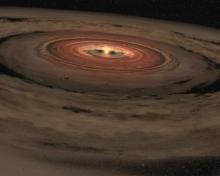
Unlike the Sun, most of the nearest stars are M-dwarf stars: small, dim, red stars that make up over 70% of the stars in our galaxy. Not only are M-dwarf stars abundant, but detecting small planets orbiting them is also easier than finding planets around Sun-like stars. As such, M-dwarfs offer ideal systems to search for Earth-like planets beyond our Solar System, and the upcoming generation of the world's largest ground- and space-based telescopes are poised to target them. To understand what kinds of planets might form around these tiny stars, we can turn to star-forming regions -- nebular clouds of gas and dust replete with newborn stars -- and directly investigate the planet-forming disks of the youngest M-dwarfs. Observations at submillimeter wavelengths with telescopes like ALMA reveal how much dusty material is available to form planets, while infrared observations with JWST are now uncovering exciting and surprising chemistry in the disks of gas and dust enshrouding these small stars -- disks that appear dramatically different from those of stars more similar to our Sun. In this talk, I will discuss the properties of M-dwarfs and what happens when we explore even smaller objects known as brown dwarfs, which are too small to undergo nuclear fusion like stars, yet too large to be considered planets. Young brown dwarfs also host disks of gas and dust, suggesting they may be capable of forming their own miniature planetary systems. With JWST, we can now extend these studies even further, down to disks of material surrounding young giant planets themselves, revealing the first insights into the environments where moons around exoplanets may form.
Please join us for light refreshments starting at 4:15pm. Looking forward to seeing you there!
**Anyone from the campus community is welcome, but note that the talk will assume at least 1-2 years of physics classes as background.